Japan’s Apartments Are Starting To Behave More Like Hotels
Service apartments are expanding in Tokyo and Osaka as longer-stay visitors look for more space than a hotel and landlords look for returns above conventional residential rents.

Japan’s hotel and residential markets are beginning to overlap in an interesting way. Serviced apartments have existed in Tokyo for years, traditionally serving expatriate executives and their families on corporate assignments. More recently, however, the model has started attracting a broader group of overseas visitors who want to stay for weeks or months, need a kitchen and meaningful living space, but do not want the commitment or inconvenience of taking a conventional Japanese lease.
The result is a product that legally remains housing but increasingly competes with hotels for the customer. Serviced apartments are defined as furnished rental housing equipped for everyday living, sometimes with hotel-style services such as linen changes and cleaning. Typical stays range from around one month to a year. That longer-stay structure is important because it distinguishes the model from hotels and short-term minpaku accommodation, even though the experience can feel much closer to hospitality than ordinary renting.
Inbound Tourism Is Changing The Customer
The growth in international travel provides an obvious demand base. Japan welcomed 42.68 million overseas visitors in 2025, while international travellers are often more likely than domestic visitors to stay for a week or longer and to travel in families or groups. Conventional Japanese hotel rooms can work poorly for that type of trip, particularly in central Tokyo where larger rooms are scarce and nightly rates have risen sharply.
A serviced apartment offers a different proposition. Guests get residential-scale kitchens, washing facilities and living space while avoiding the need to furnish an apartment, arrange utilities or navigate a standard long-term tenancy. For someone staying in Tokyo for two or three months, the comparison may increasingly be with the cost of a hotel rather than with the rent paid by a local resident. That difference can create a sizeable pricing gap.
We hope you are enjoying this free article and please continue reading on below. Uchi Insights provides the latest market news from across Japan as well as global mountain resorts, most of it for free.
But we'd love a little love!
If you want the latest data and deep-dive reports, you can access premium Uchi Insights covering pricing, sales, supply and market trends across Japan’s leading resort real estate destinations.
Twelve months of Premium access costs US$200—roughly the price of a good pair of gloves for that Japanese powder snow.
If you are buying, selling, investing or simply trying to understand where Japan’s resort property markets are moving, make sure you have the same data and analysis at your fingertips.
Don’t be the one wondering what everyone else knows.
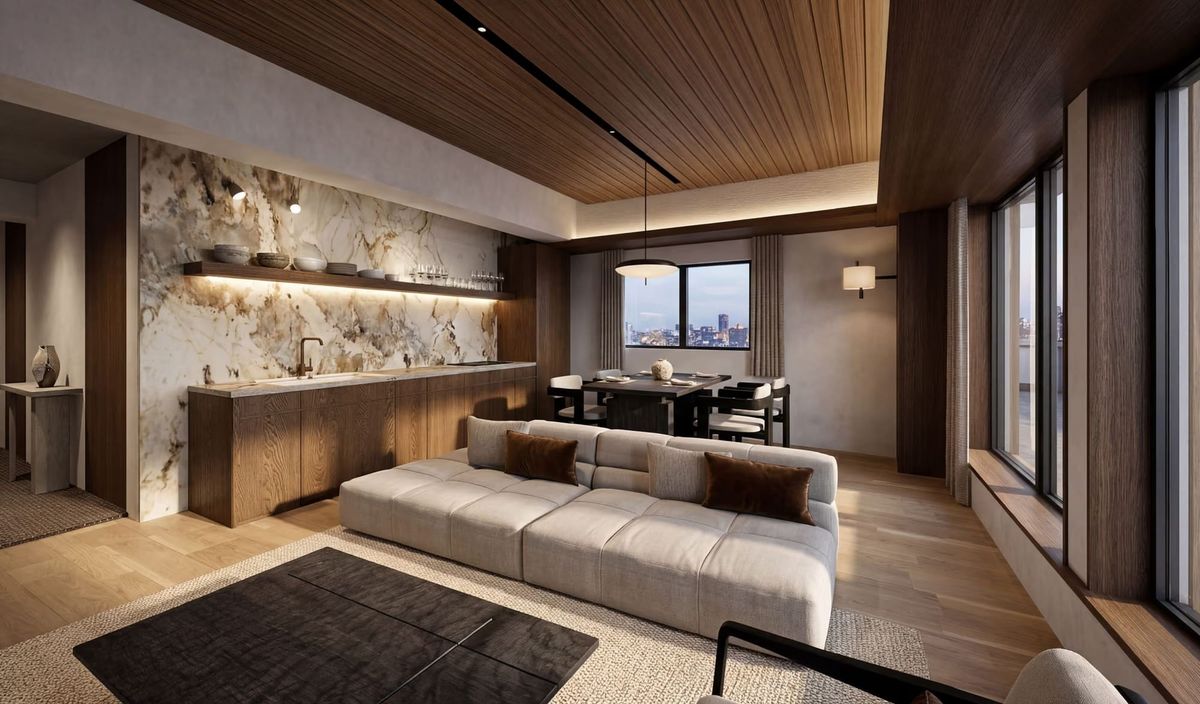
At Kyo Residence Shinjuku Yoyogi, an existing rental building acquired by JA Mitsui Leasing Tatemono is being progressively converted into service apartments. The building remains classified as residential, but vacant units are being renovated and furnished with kitchens, appliances, furniture and art to create a more hotel-like environment. Monthly rents start in the ¥400,000 range for a roughly 40 sqm studio and around ¥1.2 million for units exceeding 100 sqm.These levels are close to double normal residential rents in the area, while still comparing favourably with the cost of an equivalent long hotel stay.
Demand has appeared quickly. More than 100 enquiries were reportedly generated from renderings and online marketing before full opening, while the first two completed units received applications within roughly a week of being offered. That is a very small sample and should not be treated as proof of the economics across the sector, but it helps explain why owners and investors are paying attention.
Developers Are Building For The Model Too
This is not only about converting existing apartment buildings. Kansai Electric Power Real Estate Development has started work on its second purpose-built service apartment project in Osaka, a 52-unit development two minutes from Shinsaibashi Station. The 17-storey property will target overseas medium- and long-term residents, with furnished one- and two-bedroom apartments, cooking equipment and tableware, weekly cleaning and linen services, a fitness room and work lounge. Completion is scheduled for February 2029.
The combination of conversion projects and new development suggests that service apartments are moving beyond a niche executive-housing product. They are becoming a more deliberate response to the gap between conventional hotels and conventional rental housing.
For property owners, that gap is potentially attractive because the same physical space may support very different economics depending on how it is operated. A standard residential apartment is priced around what a local household can afford each month, while a furnished medium-stay product can be judged against the cost of alternative accommodation.
The higher headline rent does not translate directly into a higher net return. Furnishing, cleaning, utilities, management, marketing and periods between occupants all add costs that a conventional landlord may not face. Operating complexity is also greater, and the viability of the model will vary dramatically by location. Still, the revenue opportunity helps explain the growing interest.
The Existing Building Opportunity
One of the most interesting aspects of the Shinjuku example is that no new building was required. Japan has an enormous stock of existing apartments, while construction costs are making replacement increasingly expensive. If suitable buildings can be repositioned for a different customer without wholesale redevelopment, investors may be able to create value from stock that already exists.
That theme is appearing elsewhere in Japanese real estate as well. Owners are increasingly asking whether an existing asset can be renovated, repositioned or operated differently rather than demolished and rebuilt. Serviced apartments provide a particularly clear example because the change is not simply cosmetic. The target customer, length of stay, service level and revenue model all change while the underlying building can remain residential.
That does not mean every ordinary rental apartment can suddenly become a high-yielding service residence. Central locations, overseas demand, appropriate layouts and professional operation all matter, while investors also need to understand the applicable leasing and accommodation rules. The buildings most likely to benefit are those where the location already attracts people willing to pay for flexibility.
A Familiar Idea In Japan’s Resort Markets
There is also a connection to the resort property markets followed by Uchi Insights, although the legal and operating models are not identical. Niseko and other international resorts have spent years blurring the distinction between residential ownership and hospitality. Buyers increasingly expect private living space combined with furniture, housekeeping, rental management, concierge services and the ability to use an asset flexibly.
Urban service apartments approach the same idea from the opposite direction. Instead of turning a resort residence into accommodation when the owner is absent, the operator takes conventional housing and adds enough service and flexibility to compete with accommodation.
Both reflect a broader shift in what customers want from real estate. The distinction between “somewhere to live” and “somewhere to stay” is becoming less rigid, particularly for internationally mobile people. For developers and investors, that creates opportunities, but also makes operational expertise more important. The value is no longer created only by owning the square metres; it can depend on who the customer is, how easily they can use the space and what services sit around it.
Japan’s service apartment market is still small relative to conventional rentals and hotels. The recent projects in Tokyo and Osaka nevertheless suggest that the space between those two established sectors is getting considerably more interesting.
Sources
- R.E.port, “Demand Growing For Service Apartments In Central Tokyo”, 3 September 2026.
- R.E.port, “Kansai Electric Real Estate Develops Service Apartments In Shinsaibashi”, 1 September 2026.