Fukuoka’s Hotel NID Tests a Small Hotel With Larger Rooms
Fukuoka’s thirteen-room Hotel NID devotes most of its inventory to larger group-capable rooms. The business case depends on room mix, floor area and servicing costs.

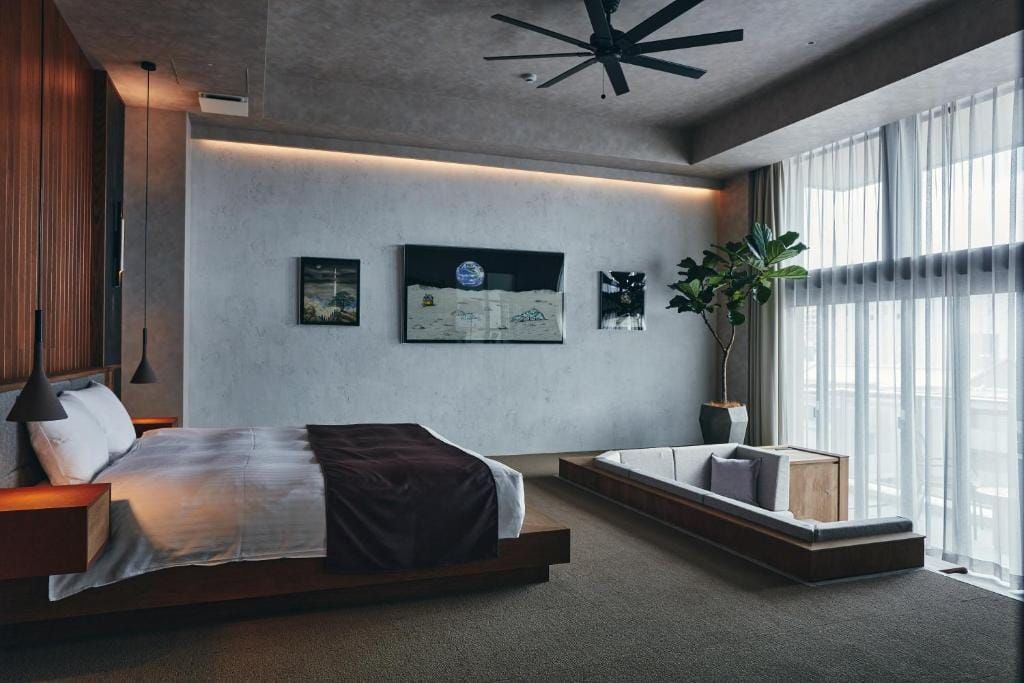
A thirteen-room hotel is a small addition to Fukuoka’s accommodation stock, but its room mix raises a useful question for developers: how much of a compact building should be devoted to space inside each stay? 7garden’s Hotel NID, whose opening was announced for 8 October in a same-day release, gives most of its rooms enough capacity to serve families or groups without requiring a large hotel footprint.
The company identifies ten 36-square-metre twin rooms accommodating up to four people, two king rooms of the same size and one approximately 72-square-metre penthouse. The penthouse adds a private sauna and terrace. A ground-floor café, which began operating on 1 October, also serves people who are not staying in the hotel. Those are three different commercial propositions within a building of only thirteen rooms.
The ten twin rooms are the core inventory. Their maximum capacity does not mean they will always be sold to four guests, or that four-person bookings necessarily produce the best margin. Larger parties may generate more revenue while adding linen, cleaning and amenity costs. The operator needs an appropriate room-price structure and a service model that works when the actual guest mix changes.
For a developer, the relevant comparison is revenue and contribution per unit of usable space. Fewer, larger rooms can appeal to customers poorly served by smaller alternatives, but that does not establish a superior return on construction cost. Circulation, bathrooms, plant and shared facilities all consume area too. Comparing a room’s nightly price without its development and operating requirements gives an incomplete account of the building.
Understand the market around the mountain.
Follow our coverage of Japan and global mountain destinations, then explore Uchi Insights Premium for detailed property data and market reports on Japan’s resort markets.
Your free article continues below.
The single penthouse introduces a further source of variation. One exceptional room may strengthen positioning, yet any revenue assumption attached to it rests on a small number of available nights. Its achieved rate, occupied nights and maintenance needs should be visible separately rather than hidden in a whole-hotel average. That makes it easier to see whether the premium specification is earning its additional cost.
The café offers another way to use limited space, bringing local custom into the property outside the overnight booking cycle. Its value depends on its own trading economics and the service it provides to guests. A welcoming ground floor may improve the experience, while still requiring labour and purchasing discipline to avoid becoming an expensive amenity.
Hotel NID is useful as a product-design case rather than proof of a market-wide shift. The opening release provides room counts and specifications, not stabilised occupancy or profit. Its performance will depend on finding the customers those larger rooms suit and operating the mix efficiently. That is the evidence another owner should seek before copying the format into a different neighbourhood or resort.