Land Is Two Markets: Asking Values, Sold Values and Plot Size
Large land can push ticket prices higher while ¥/sqm falls. Uchi separates small plots from development-scale sites and compares what sellers ask with what has actually sold.

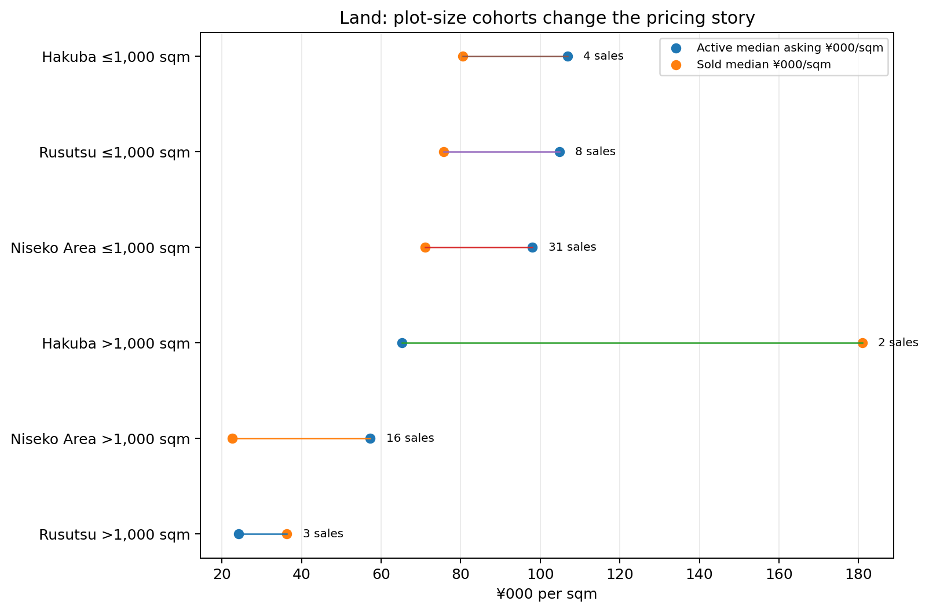
Land is the easiest property type to misread because total ticket price and value per square metre often move in opposite directions. Niseko’s all-Land active average asking value was broadly stable between winters, while the active median ticket fell and average asking ¥/sqm increased. The average indicative sold-listing value fell sharply at the same time that sold ¥/sqm increased. Those numbers only become intuitive once the market is separated into plots up to 1,000 sqm and land above 1,000 sqm.
The smaller cohort is closer to the private-buyer and small-development market. The larger cohort contains estate and development-scale opportunities where a single parcel can be worth hundreds of millions of yen but carry a much lower ¥/sqm because of scale. Uchi’s report already provides these cohorts, so there is no reason to force them back into one average when the analytical question is value.
Rusutsu makes the distortion especially obvious. Its all-Land active average asking value rose by more than 250% between winters, while active median asking ¥/sqm fell by roughly half. That is not a contradiction: the market contained much larger and more expensive total parcels. The member section below separates the cohorts and places the asking market beside the properties recorded as sold.