The Resort Momentum Map: What Sellers Are Asking vs What Buyers Are Buying
Some resort averages moved dramatically in Winter 2025/26. The active asking market often moved far less. Uchi separates sales composition from broader pricing to identify the kind of momentum each resort actually has.

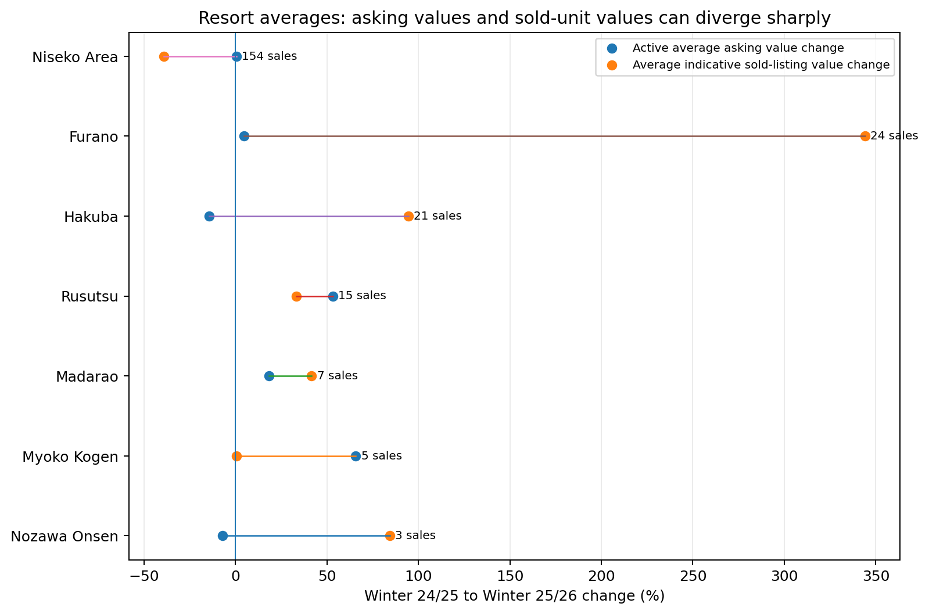
The headline resort numbers are striking. Niseko recorded 154 sales in Winter 2025/26, Hakuba 21, Furano 24 and Rusutsu 15. Those counts all rose from the previous winter, but the price story is not remotely uniform. In some resorts, what sold became more expensive; in others, the sales sample shifted towards cheaper product even while the broader asking market held firm.
Niseko is the most obvious contradiction. Its blended average indicative sold-listing value fell 39%, but the average asking value across the cumulative active pool changed by only +0.5%. Hakuba moved the other way: the blended average sold value nearly doubled while the average asking value of the active pool fell by about 14%. Those are not errors; they tell us that the properties buyers absorbed were not a neutral sample of everything available.
Furano and Rusutsu demonstrate why the same caution applies when the headline is positive. Furano’s blended sold average rose dramatically because the current sales mix contains more apartments and houses rather than being dominated by low-ticket land. Rusutsu’s active asking average rose sharply as much larger and more expensive land parcels entered the cumulative active pool. Neither figure should be described as a simple resort-wide price appreciation rate.
The useful question for a buyer or seller is therefore not which resort has the largest percentage change. It is whether asking prices are holding or moving, whether buyers are absorbing the same product or a different one, whether ¥/sqm confirms the ticket-price movement, and whether the available sample is deep enough to make the result robust. The member analysis below uses those dimensions to classify the current resort momentum rather than rank it.
Want to read on and get the whole article, along with the full Winter 2025/26 Resort Intelligence series?
Everything is available to Uchi Insights Premium subscribers, together with our complete archive of reports and analysis across Japan’s leading resort markets.
Twelve months of Premium access costs US$200—roughly the price of a good pair of gloves for that Japanese powder snow.
If you are buying, selling, investing or simply trying to understand where Japan’s resort property markets are moving, make sure you have the same data and analysis at your fingertips.
Don’t be the one wondering what everyone else knows.