The Asking Market: What Properties For Sale Are Telling Us
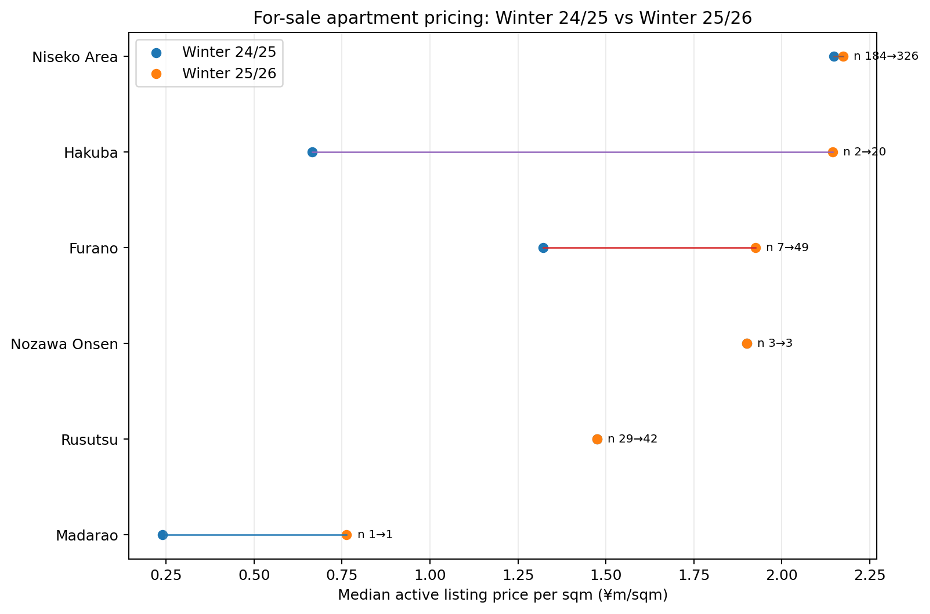
Niseko apartment sold values fell sharply, yet the median asking price did not move. Hakuba apartment tickets fell while asking ¥/sqm surged. The active market changes the interpretation of the sales data.

A sold-unit average can move because market prices changed, because buyers selected a different part of the market, or because one development supplied a large share of the transactions. The active-listing data gives us a second lens. It is not perfect—large developments can also dominate active inventory—but it usually contains many more observations, and medians help reduce the influence of unusually expensive or inexpensive properties.
The latest Uchi files allow two useful asking-market comparisons. Calendar 2024 versus calendar 2025 tells us whether a direction persisted across a full year. Winter 2024/25 versus Winter 2025/26 gives us a like-for-like seasonal comparison. Because those periods overlap, we do not connect them as a four-point time series; instead, we ask whether the annual and winter signals reinforce each other or whether the market is changing composition too quickly for a simple trend line.
Niseko apartments illustrate why this matters. The average indicative value of apartments recorded as sold fell about 45% between winters, yet the active median asking price was unchanged at ¥180.0m and median asking ¥/sqm edged higher. Across calendar 2024 to 2025, the active median asking price moved only modestly lower and median asking ¥/sqm was again broadly flat. That is much closer to a stable broader asking market than to a 45% market-price collapse.