Niseko Is Not One Market
Niseko’s parent-level sold average fell sharply while active asking values were much steadier. The explanation sits inside Hirafu, Other Niseko, Kutchan and the other sub-markets.


At parent level, Niseko looks dramatic. Recorded sales increased from 107 to 154, while the average indicative sold-listing value fell from ¥150.3m to ¥91.5m. The active market tells a much less dramatic story: the average asking value across the cumulative active pool changed by only +0.5%, while the active median moved from ¥150.0m to ¥141.0m.
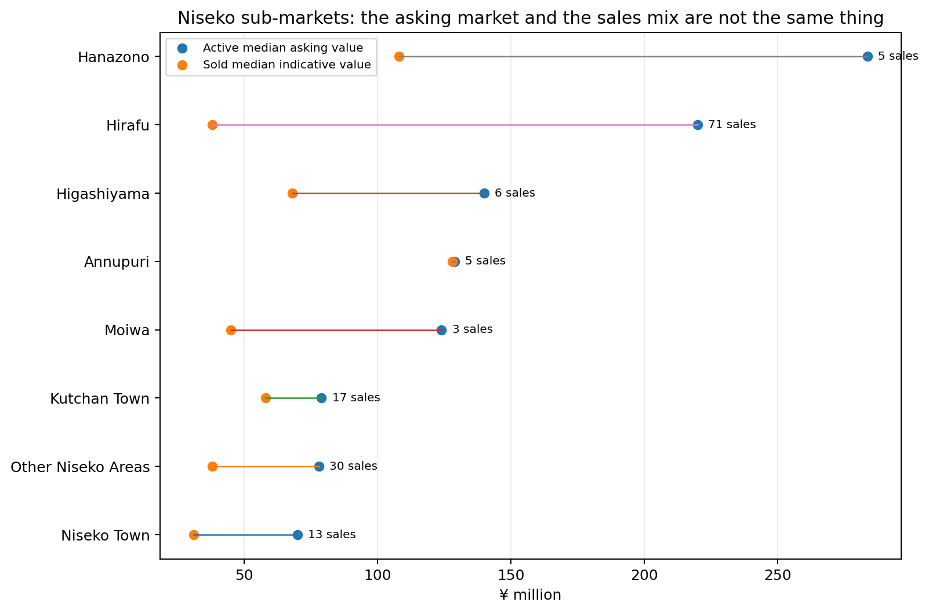
That divergence is not evenly distributed across the region. Hirafu experienced a major change in apartment sales mix. Other Niseko Areas sold a relatively large number of lower-ticket houses and land. Kutchan’s sales count was unchanged but its observed velocity improved materially. Hanazono remains much more expensive but is supported by a tiny transaction sample. Niseko Town and Moiwa occupy still different price and product positions.
The practical consequence is that a single Niseko average has become a poor shortcut. Buyers deciding between a ¥40 million compact apartment, a ¥200 million Hirafu house, a Kutchan residence or a development-scale land parcel are participating in markets with different supply, value density and liquidity. The member section below reconstructs the parent-level movement from the sub-areas rather than treating ‘Niseko’ as one homogeneous price series.